
Request for Utrecht study put on hold
Academic Freedom Index: academic freedom declining worldwide
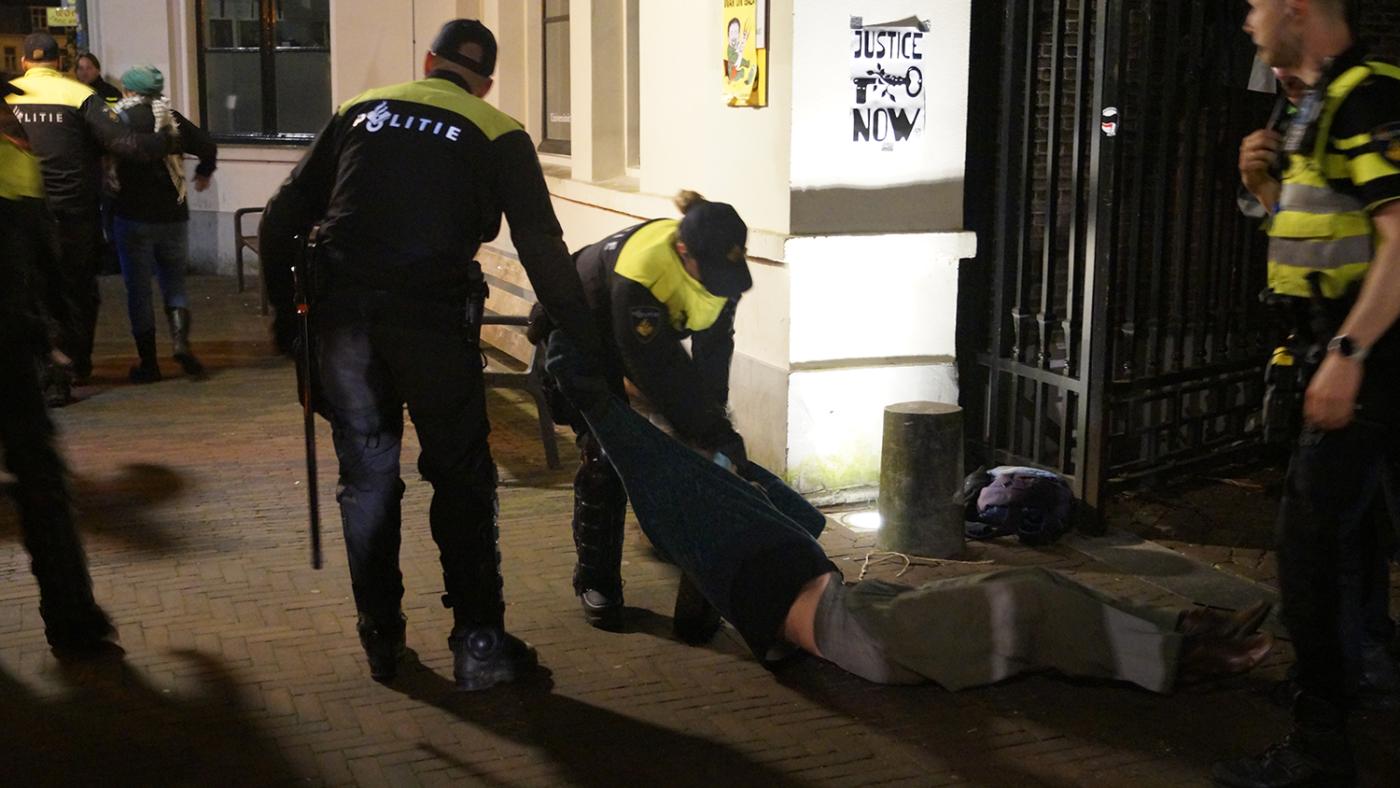
Police repression during protests contributes to a lower score for “campus integrity”. Photo: DUB
Are academics free to decide what they research and teach? Is the campus a safe place for students and staff? Can academics speak freely, even about sensitive topics?
The Academic Freedom Index annually assesses the level of academic freedom in countries, based on questionnaires and evaluations by local experts. Countries are then awarded a score between 0 and 1.
Europe, North America, Oceania and Latin America generally fare well, whilst countries in Asia, the Middle East and parts of Africa often score lower. Nevertheless, academic freedom has declined significantly in fifty countries over the past ten years.
The ranking
The Czech Republic tops the new ranking with a score of 0.98. It is followed by Estonia with 0.97 points. Belgium takes third place with 0.95 points.
Nicaragua languishes at the bottom of the list. The country still scored 0.81 points in the 1990s, but it has since slipped into a dictatorship under Daniel Ortega, who returned to power in 2007. According to a UN report, universities in Nicaragua are under strict control, and critical students and lecturers face “physical and psychological violence”.
The Netherlands
The Netherlands scored 0.76 points, which is lower than most EU countries. Only Greece, Romania, and Hungary score lower. The Netherlands was among the frontrunners for years, but that is no longer the case.
For instance, "campus integrity" is rated relatively low in the Netherlands. Scholars at Risk recorded several incidents over the past few years, including police violence during pro-Palestinian protests, as well as vandalism of university buildings committed by activists. According to the organisation, such incidents contribute to a feeling of insecurity on campus and hinder an open debate.
The Royal Netherlands Academy of Arts and Sciences (KNAW) also warned last year that academic freedom in the Netherlands is under pressure, partly due to the substantial cuts by the previous cabinet and the "polarisation of public debate". KNAW also cited the Netherlands’ falling score on the Academic Freedom Index.

© HOP, Source: Academic Freedom Index.
Nuance
A high score does not always mean that a country provides a safe learning environment. For example, Nigeria scores significantly better than the Netherlands, even though students and staff in that country have been kidnapped on several occasions in recent years by criminal gangs, often for ransom.
The Academic Freedom Index focuses on the degree of government interference with institutions. Issues such as crime and general safety are, in principle, not taken into account.
Trump administration
The most dramatic decline can be seen in the United States, where academic freedom has fallen by as much as fifty per cent. With a score of 0.40, academic freedom there is now even more restricted than it was in the Netherlands during the Second World War.

© HOP, Source: Academic Freedom Index.
Trump regards universities as adversaries and exerts heavy financial pressure to force them into compliance. Researchers must adhere to strict guidelines on diversity, equality and inclusion, and lecturers are no longer free to teach topics such as racism and gender. Even Plato’s writings had to be removed from the reading list.
In Hungary, India and Turkey, academic freedom is increasingly under threat due to legislative changes and government intervention. Unlike in the United States, where the decline has occurred rapidly, in these three countries it has happened more gradually.
A memorandum was on the agenda of the University Council this week, calling for a local study into "the state of academic freedom" at Utrecht University. Among other things, this should provide insight into academics’ freedom to conduct research and teach, as well as into campus safety and freedom.
The motion is an initiative of council member Lloyd-Leonard Opdam, who was part of the VSP party and now operates under the brand Academisch Belang Utrecht (Academic Interests Utrecht). Six staff members support the motion. Three of the four other student parties endorse the call for an investigation. The largest faction, Vuur, did not sign the motion.
In response, the rector asked the council to wait for a study currently being conducted by the Royal Netherlands Academy of Arts and Sciences (KNAW) on behalf of the Ministry of Education, Culture and Science. This study will address the distinction between freedom of expression and academic freedom in a scientific context, among other things.
The council agreed to this request. The KNAW study is expected to be completed in August.
Comments
We appreciate relevant and respectful responses. Responding to DUB can be done by logging into the site. You can do so by creating a DUB account or by using your Solis ID. Comments that do not comply with our game rules will be deleted. Please read our response policy before responding.