
Excluded from student houses
'Internationals need not apply'
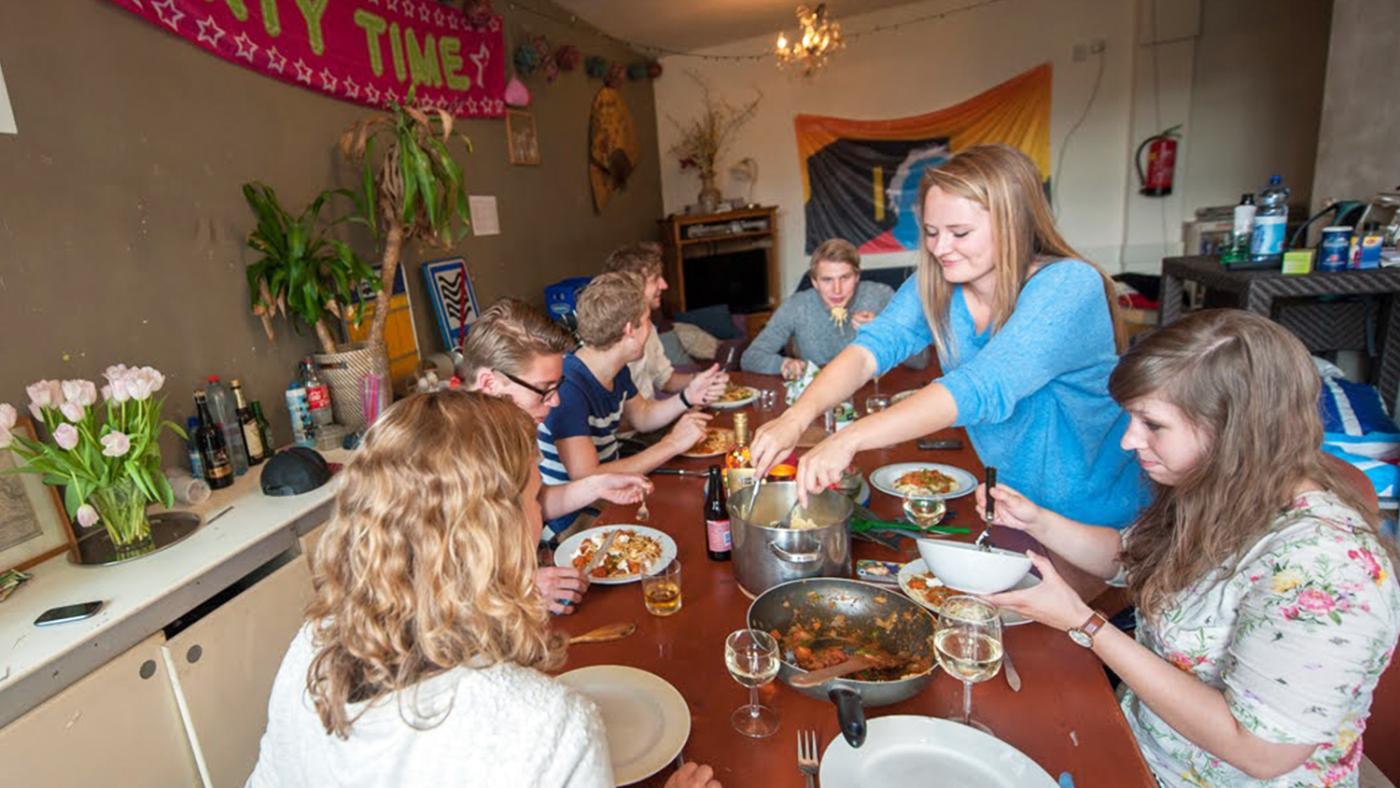
A typical Dutch student home. Photo: SSH
If you’re a student in the Netherlands, you’ve likely experienced the difficulty and pain of finding a house. During this process, you may have heard of hospiteeravonds or “introduction evenings.” These are opportunities for students to view houses and introduce themselves to their would-be roommates.
Rather than having to present themselves to a landlord, students instead have to present themselves to the people already living in the student house, as they are the ones who ultimately decide who gets to moves in. These houses also tend to be much cheaper than those you’ll find on the private market.
Given the housing shortage, these auditions are very competitive. As a friend of mine told me, sometimes as many as 50 or 60 people attend.
Yet when I was looking for a place this past spring and summer, the thought of attending a hospiteeravond was nowhere near the top of my priorities because I knew that my chances of getting a room that way were slim. That’s because non-Dutch speakers are very often eliminated first.
When talking to Dutch friends and colleagues, many say the quiet part out loud. Dutch students (most of the time) want to live with other Dutch students. A half-Dutch colleague of mine told me about his old house, where he had no issue because he spoke Dutch. However, whenever they held a hospiteeravond, his roommates would usually eliminate the internationals very quickly.
Another former classmate of mine advertised a room on her Instagram. I asked her if they accepted internationals and she replied: “No, sorry.”
What are the consequences of this? DUB has written many times in the past that Dutch students and internationals don’t mingle much. This is part of the broader development of two parallel student cultures. Some aspects are enforced by the university, such as separate introduction weeks, while others are more informal, with Dutch and international students joining different associations, attending different parties, and choosing to mingle less with each other.
Very few internationals get the chance to live with Dutch housemates, meaning that they miss out on many potential friends. It also reinforces a perception, that some internationals have, that they are not wanted here, which makes them less interested in learning about or participating in the local culture.
When internationals are surrounded only by other internationals, they have no real incentive or motivation to feel part of Dutch society. Within international circles, many try learning Dutch but give up rather easily. Others never bother learning it at all, as their entire life in the Netherlands is in English.
On a financial level, it also means that internationals who cannot get the few student housing options available for internationals through SSH, Xior, or Plaza, must go to the private market. More often than not, their rent skyrockets as a result. I personally had an SSH short-term contract that couldn't be renewed and had to start looking at the private market. My monthly rent went up several hundred euros.
Even the internationals lucky enough to get student housing often pay more than their Dutch counterparts, who get their apartments through long-stay and other waitlist services, which internationals are not on because they most likely did not know they would be in the Netherlands three or four years ago.
To be clear, this piece is not an attack on Dutch students who wish to live with other Dutch students. It is very common for people to want to surround themselves with people they have things in common with. In this case, language. Some Dutch students I know tell me about how they have to speak English at school and work, so they want to be able to speak their mother tongue at home. It is a perfectly understandable feeling.
This piece is not meant to say that Dutch students necessarily have malice toward internationals, either. Many of them hold no ill will toward internationals and are curious about other cultures and countries. There are also definitely many Dutch students who would feel comfortable living with internationals.
However, it must be acknowledged that, due to internationals often being excluded for not speaking Dutch, hospiteeravonds often perpetuate the growing divide within the Netherlands between Dutch and international students.
This has created two parallel student cultures which only feed into social polarisation, and drive these groups further apart.
International students are not the only ones who have a hard time with hospiteren culture. The student housing provider SSH recently decided to ban the practice in their future buildings. Students in existing buildings can retain the right to choose their own roommates.
The opinions expressed above belong to the author and do not necessarily represent the opinions of DUB's editors. Would you also like to become a blogger? Send an e-mail to dubredactie@uu.nl
Comments
We appreciate relevant and respectful responses. Responding to DUB can be done by logging into the site. You can do so by creating a DUB account or by using your Solis ID. Comments that do not comply with our game rules will be deleted. Please read our response policy before responding.